
 Refrigerator Repair
 Dishwasher Repair
 Washer Repair
 Electric Dryer Repair
 Oven Repair
 Stove/Cooktop Repair
 Freezer Repair
 GAS Appliance Repair
 Appliance Installation
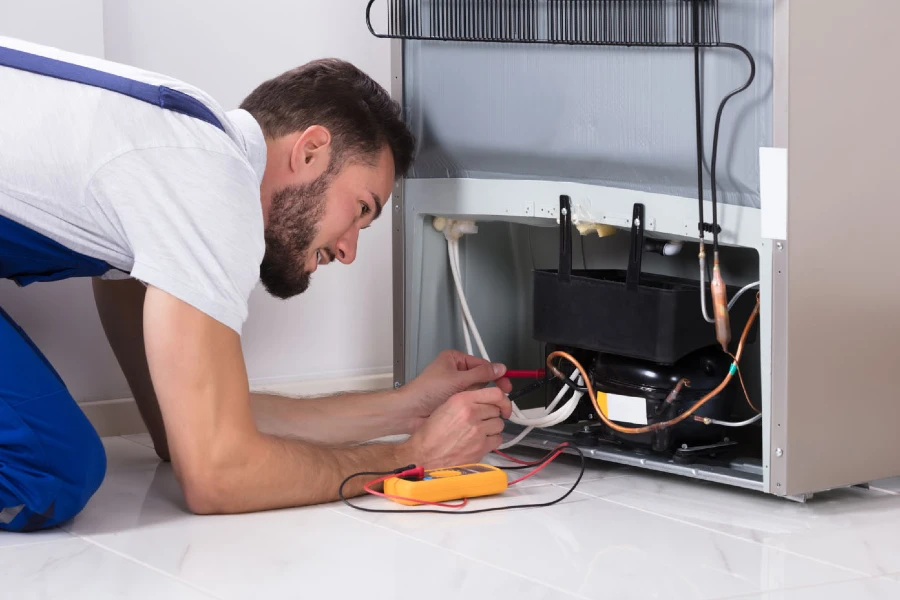
Asko Appliance Repair Services
We repair Asko dishwashers, washers, dryers and drying cabinets, the only categories Asko sells in Canada, and all of them electric. Parts and codes are keyed to the type number on the plate rather than the model on the badge. Labour runs $92 to $278, and the service call is free with the repair.
Your Local Appliance Repair Company
- Experienced technicians
- Manufacturer parts where they are available
- Convenient Scheduling
- Prompt Service
- Diagnosis at your address
- Quoted before work starts
- Warranty up to 3 months
- Transparent Pricing

Article Reviewed & Technically Verified by Dmitriy D., Lead Appliance Repair Technician, ODP-Certified (15+ Years Experience)
What customers said about their Asko repair
Verified reviews from our Google Business Profile.
“Dmitriy did a good job fixed my fridge”
“Dimitriy was amazing! He fixed my dryer and cleaned my vents. He was personable and explained everything along the process.”
“Dmitriy was able to identify the problem and fix my fridge same day, after hours. Highly recommend”
“Dmitriy did a good job fixed my dishwasher”






Find Your Asko Fault
Start with the appliance and what it is doing. Asko uses three different code formats depending on the machine, and the washers spell the fault out in words rather than numbers. Plenty of what we are called to shows no code at all.
| Appliance | What it is doing | On an Asko this is usually | Code, if any |
|---|---|---|---|
| Dishwasher | Water on the floor, machine stopped | Aqua Safe has detected a leak and shut the machine down. Asko's own instruction is to turn off the supply valve and leave the plug in until you have | F54, F40 |
| Dishwasher | Water sitting above the filters | The coarse and fine filters, then the drain pump. Filter neglect is the single most common cause on this brand | F11, F68, F52 |
| Dishwasher | Not filling | The supply valve, then the outer filter on the inlet hose, which Asko documents as a routine blockage you can clear yourself | F12, F67 |
| Dishwasher | Runs a full cycle but dishes come out dirty | A fractured circulation pump impeller. The motor still spins, so the machine sounds normal while moving no water | F56, or legacy F9 |
| Dishwasher | Not heating, dishes cold and wet | The heater in the circulation pump assembly. Asko's own action here is to unplug it and call service | F41, legacy F1 |
| Dishwasher | White film on glasses, chalky residue | Limescale. Asko prescribes its Self-cleaning program with two tablespoons of citric acid, and forbids CLR or drain cleaners outright | none |
| Dishwasher | Smells bad | The coarse and fine filters and the sump. A ten minute clean solves most of these without a visit | none |
| Dishwasher | Dead, no lights | The outlet and breaker first. These are 120V 15A machines on a dedicated circuit | none |
| Washer | Water on the floor | Not the door boot, because Asko does not fit one. Check the inlet hoses first, then the drain hose and pump housing | E11 OVERFLOW |
| Washer | Door will not open | The interlock holds until the drum drains. Drain at the filter first rather than forcing it | E23, E2 |
| Washer | Will not fill | Inlet valve, hose filter and tap. Asko specifies supply pressure between 0.1 and 1 MPa | E3 WATER FILLING |
| Washer | Will not drain | Pump filter, drain hose and the standpipe height, before the pump itself | E7 DRAINING |
| Washer | Will not spin | Load distribution first. The machine reports imbalance separately from a genuine spin fault | E8, UNBALANCE |
| Washer | Banging or walking | Transit bolts left in after a move, then the tub shock absorbers, parts 415388 and 415390 | E13.1, E13.2 |
| Washer | Not heating the wash | The element or the thermistor. The display names which one | E6, E1 |
| Washer | Musty smell | Run the drum cleaning program. Asko prompts for this itself with a steril tub alert | STERIL TUB |
| Washer | Detergent not dispensing on a Style model | The auto-dosing hardware. These codes exist only on the dosing machines, which in Canada means the W6124XW | E31 to E34 |
| Dryer | Takes far longer than it used to | Filters first on every type. On a heat pump the condenser block as well, and on a vented machine the duct run | E-4 on heat pump |
| Dryer | Water on the floor under a heat pump or condenser model | The condensate pump or the tank seal. A vented Asko has neither, so this fault cannot occur on one | E-3 |
| Dryer | Tumbles cold | On a vented machine, the heater 562796 or the NTC sensor 581213. There is no code to read on these | none on vented |
| Dryer | Rumbling or squealing | Drum bearings and the belt. Asko builds five ball bearings into each dryer, so these are stocked service parts | none |
| Dryer | Stops part way through | Filters and airflow on a vented machine. On a heat pump, a maximum program time fault | E-5 |
| Dryer | Getting too hot, or a burning smell | Stop using it. Lint against the heater and a blocked duct are the usual pair, and this one is a fire risk | none |
| Drying cabinet | Alarm or error on the display | Asko's own first step is to hold START/STOP for five seconds to reset. The vented Canadian model publishes no code meanings | ERROR 03 to 12 |
| Wine cabinet | Not holding temperature | Door seal and the sensor before anything in the sealed circuit. Sealed work in Ontario needs an Ozone Depletion Prevention certificate | none published |
| Any | A code that matches nothing you can find | Read us the type number and the Art. No. from the plate. Asko documentation is indexed by type, not by the badge | any |
| Dishwasher | Dishes coming out wet | Rinse aid empty before anything else, then the drying fan and the heater. Asko dries with Turbo Combi rather than a bare element, so both are checked | none |
Leaking right now? Close the supply valve, switch the appliance off at the breaker and call us rather than running another cycle. On an Asko dishwasher the machine has usually shut itself down deliberately, which means the leak protection worked and the damage stops there.
What Asko Sells in Canada, and What It Does Not
Worth settling first, because this brand is smaller here than its reputation suggests. Asko reaches Canada through a single exclusive distributor, Distinctive, which has held the brand since 1 July 2022 and honours warranties written by the previous distributors. The Canadian range is narrow, and every appliance in it is electric.
| Category | Sold in Canada? | Canadian model examples |
|---|---|---|
| Dishwashers | Yes | DBI564IS, DBI565IXXLS, DFI565XXLSOF, DBI776IXXLSSOF, DBI786IXXLSSOF, DSD565, DOD561TXXLS |
| Washing machines | Yes | W2084W Classic, W4114CW and W4114CT Logic, W6124XW Style |
| Tumble dryers | Yes | T208VW vented, T208CW condenser, T208HW heat pump, T411VDW, T411HSW, T611VUW |
| Drying cabinets | Yes | DC7784VW, a 72 inch vented cabinet |
| Wine climate cabinets | Yes | WCN311942G three zone, WCN111942G single zone |
| Refrigerators and freezers | No | Wine cabinets are the only cooling appliance Asko sells here |
| Ovens, cooktops, rangehoods | No | The OP and HI series are European and Australian only. None reaches Canada |
Two corrections that circulate widely. Asko sells no ovens or cooktops in Canada, so any page offering you Asko oven repair here has not checked. And in Asko's Canadian laundry range HI means a pull-out ironing board, part of the Hidden Helpers accessories, not an induction hob. The HI-series induction hobs exist, but only in Europe and Australia.
If you were looking for a brand sold across the full kitchen, our fridge repair, oven repair and stove and cooktop repair pages cover the makes that do.
The Type Number Is What Orders Parts
This is the single most useful thing to know about servicing an Asko, and it is why owners searching their own model number come up empty.
Asko indexes its technical documentation and its spare parts by a type number, not by the model on the badge. The plate carries four identifiers: TYPE, MODEL, Art. No. and Ser. No. The type tells a technician the platform, and the platform is what the parts list is written against. WM is a washing machine platform, TD a tumble dryer, DW a dishwasher. A W4114C.W.U is type WM85.14100. A T411VD.W.U is TD85.1110. The current DBI and DFI dishwashers are DW40.2, while the older D5000 machines are DW20.
It matters commercially as well as administratively. One badge model can span several Art. No. revisions with different parts: on the DW40.2 platform, one build takes drain pump 573752 and another takes 563263, both described as the same 120V Leili pump. Order from the badge alone and there is a real chance of the wrong part and a second visit.
Where the plate is. On a dishwasher, the right side of the inner door panel or tank. On a washer, above the glass door on the inner panel. On a dryer, behind the door in the upper left corner. On a drying cabinet, the upper left side wall inside. Read us all four numbers when you call.
Asko Dishwasher Repair
The Canadian dishwashers are the DBI models with a visible steel panel and the DFI panel-ready models, in 30 through 60+ series, with XXL denoting the taller tub and SOF a built-in water softener. The softener is a model-specific option rather than standard, which matters in hard-water areas: a DBI564IS has none, while a DBI776IXXLSSOF does.
Two code generations, and they do not overlap. The current DBI and DFI machines use two-digit F-codes. The older D5000-era machines use single characters F1 through FB, signalled through the L1 to L12 indicator lights rather than a display. Reading the wrong table sends the repair the wrong way.
| Code | Asko's published meaning | Checked first |
|---|---|---|
| F10 | Overfilling water 1 | The drain pump, which Asko documents as owner-clearable |
| F11 | Water outlet fault | Filters and sump, then the drain hose |
| F12, F67 | Water inlet fault 1 and 2 | Supply valve on, then the inlet hose filter |
| F40 | Inlet valve leakage | Supply pressure, which Asko specifies at 4.2 to 140 psi |
| F41 | Heater fault 1 | Asko's instruction is to isolate and call service. Not an owner job |
| F45 | Diverter fault | Re-run a programme once before condemning anything |
| F52 | Water level fault | Clean the coarse and fine filters, which is Asko's own first action |
| F54 | Overfilling water 2 | Turn off the supply valve first, and leave the plug in until you have |
| F56 | Circulation pump fault | The impeller. On this brand it fractures while the motor keeps running |
| F68 | BLDC drain pump fault | Filters and pump chamber before the pump is replaced |
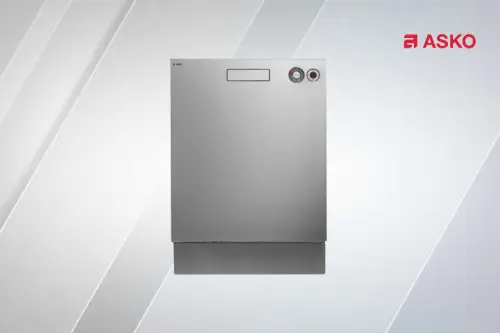
These are the codes Asko publishes in its own user manuals for the current DBI and DFI machines, and in its dishwasher service documentation for the earlier platform. Asko's regional websites are app-driven and carry no public code index, which is why a table like this is hard to find.
On the older D5000 machines the equivalents are F1 temperature stop, F2 overfilling, F3 thermistor, F4 water intake, F5 valve leakage, F6 pressure sensor, F7 pumping out, F8 blocked filter, F9 circulation, FA turbidity sensor and FB spray arm divider. Note how many rows on both lists end at the filters. The parts behind the common faults are ordinary: drain pump 573752 or 563263 depending on the build, circulation pump 512070 or 512073, door gasket 426743, inlet valve 514530.
One caution specific to Asko: pressing any button clears the error message, so a machine that has been reset tells you nothing. Note the code before you clear it. See also dishwasher repair.
Asko Washer Repair
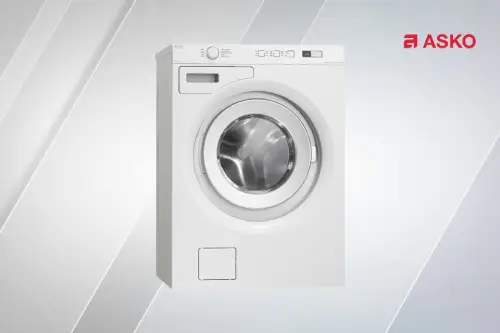
Three Canadian washers: the 24 inch W2084W Classic at 2.1 cubic feet, the W4114CW and W4114CT Logic at 2.8, and the W6124XW Style with automatic dosing.
Asko washers tell you the fault in words. Rather than a bare number, the display shows text such as DOOR LOCK ERROR, WATER FILLING ERROR or DRAINING ERROR, and pressing INFO brings it up. That is genuinely useful on the phone, so read us the words rather than translating them into a code.
There is no rubber door boot on these machines. Asko fits Steel Seal, a steel door seal in place of the folded rubber bellows every other front-loader uses, which is why an Asko does not grow mould in the door fold. It also means a technician quoting you for a door boot has the wrong brand in mind. The serviceable part is door seal 708850.
The recurring parts are the drain pump 496467, the tub shock absorbers 415388 and 415390, the door lock 370946 and the drive belt 415387. A machine that bangs on spin is load distribution or those dampers, and Asko's Quattro construction rests both drums on shock absorbers, so worn dampers show up as noise long before anything fails. See washer repair.
Two details on the code list worth knowing. E14 to E22 and E24 to E28 are not used at all, so a table showing them is invented. And E29 through E34 exist only on auto-dosing machines, because they refer to the peristaltic pumps and detergent level sensors. In Canada that means the Style W6124XW; on a Classic or Logic those codes cannot appear.
Asko Dryer and Drying Cabinet Repair
The Canadian dryers come in three heat types and the difference decides the diagnosis. Vented: T208VW, T411VDW, T611VUW. Condenser: T208CW. Heat pump: T208HW, T411HSW. All electric.
Vented Asko dryers publish no error codes. The manual carries a symptom table and nothing else, so if yours has no display showing a code, nothing is wrong with the display. Tell us what it does instead: whether the drum turns, whether it heats, and how long a normal load now takes.
The heat pump machines do publish codes, and one is diagnostically precise. E-0 is the control unit, E-1 the temperature sensor, E-3 the pump that moves condensate to the tank, E-4 a filter error you can often clear yourself, and E-5 maximum program time. E-3 is worth understanding: a condensate pump only exists on a heat pump or condenser machine, so that fault cannot occur on a vented dryer, and water on the floor under one of those is never the drum.
The vented platform's service parts are the belt 562079, drum bearing 450071, NTC sensor 581213, heater 562796, door switch 561850 and fan 465840. Asko builds five ball bearings into each dryer, which is why bearing and roller wear is a routine repair rather than a write-off. See electric dryer repair.
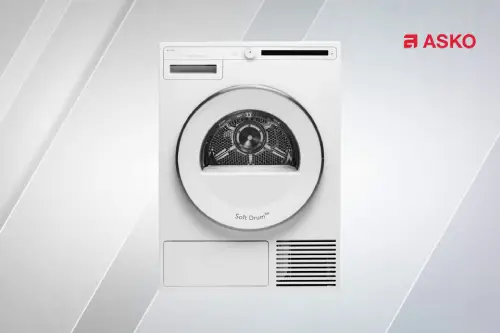
The drying cabinet splits the same way. The Canadian DC7784VW is vented and publishes no code meanings, and Asko's own first instruction for any alarm on it is to hold START/STOP for five seconds to reset. The heat pump cabinets sold in other markets do publish a list, where ERROR 03 is the moisture sensor, ERROR 04 the maximum drying time, ERROR 06 the water tray float and ERROR 12 a communication interruption.
A Safety Recall Worth Checking
Warranty, and Who Should Do the Work
We would rather you hear this from us. Asko's Canadian warranty runs two years on residential products, and the promotional five year cover some dealers advertise is an extension of that two, not a separate scheme. The important clause is that it covers parts and labour only where the service is obtained from an authorised Asko service company, and it excludes unauthorised repairs by non-Asko technicians.
So if your appliance is still inside that window, call Distinctive first. Its Canadian parts and service page carries the Asko service line and the warranty document itself. Using an independent company on a covered machine can affect the cover, and no repair we do is worth costing you a warranty.
Where we are useful is everything outside it: machines past two years, appliances bought with a house, owners who want a diagnosis and a price before deciding, and the ordinary filter, pump, seal and bearing work that makes up most of what these machines need. We are an independent repair company rather than an Asko-appointed servicer, and we say so plainly.
One more thing worth knowing if you are reading an older manual: the North American support address printed inside it is a dead domain that has been taken over by an unrelated site, so do not follow it. The Canadian route is through Distinctive.
Parts for an Asko in Canada
Better than the brand's boutique reputation suggests. Asko parts are stocked in Canada and ship to every province we cover, and the numbers are ordinary catalogue items rather than special orders: the dishwasher door gasket 426743, the washer door seal 708850, the dryer belt 562079.
The catch is the one described above. Because parts lists are written against the type and the Art. No. rather than the badge model, giving a parts desk only "W4114CW" can return the wrong revision. Give us all four numbers off the plate and we check availability against your exact build before booking, then quote the wait with the price.
Whether the repair is worth doing is a separate question, and on a premium machine the arithmetic usually favours repair. Our guides on repairing or replacing a dishwasher, a washing machine and a dryer set out how we weigh it. If you are comparing against the other European makes we service, our Bosch, Miele and Ariston pages cover the same ground.
We have technicians based in eight regions rather than dispatched from one hub: the GTA, Barrie, London and Ottawa in Ontario, Vancouver in British Columbia, Winnipeg in Manitoba, Halifax in Nova Scotia, and New York City. Each has its own local number. Asko is a specialist-dealer brand, so most of this work sits in the larger urban markets. The service areas page lists the number nearest you.


