
 Refrigerator Repair
 Dishwasher Repair
 Washer Repair
 Electric Dryer Repair
 Oven Repair
 Stove/Cooktop Repair
 Freezer Repair
 GAS Appliance Repair
 Appliance Installation
AEG Appliance Repair Services
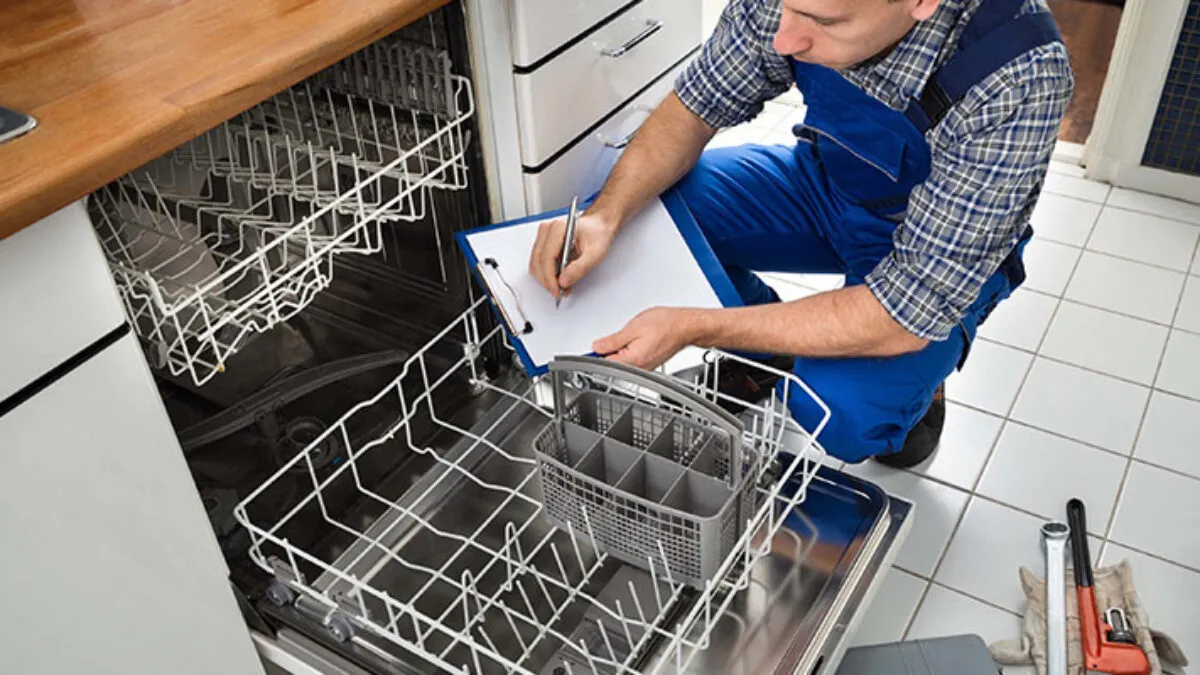
We repair AEG dishwashers, wall ovens, induction cooktops, rangehoods and ARCTIS refrigerators. Tell us the code on the panel, or simply what the appliance does and when it does it, and we will tell you what it usually turns out to be before anyone is dispatched. Labour runs $92 to $278, and the service call is free with the repair.
Your Local Appliance Repair Company
- Experienced technicians
- Manufacturer parts where they are available
- Convenient Scheduling
- Prompt Service
- Diagnosis at your address
- Quoted before work starts
- Warranty up to 3 months
- Transparent Pricing

Article Reviewed & Technically Verified by Dmitriy D., Lead Appliance Repair Technician, ODP-Certified (15+ Years Experience)

Find Your AEG Fault
Start with what the appliance is doing. Each row is the cause we find most often on AEG specifically, and the code column covers every display format the same fault uses.
| What it is doing | On an AEG this is usually | Code you may see |
|---|---|---|
| Dishwasher will not fill | Scale in the tap-end inlet filter. On a new install, a blanking plug left in the sink trap | i10, i11, AL5, C1 |
| Dishwasher will not drain | Filter and sump, or a drain height outside AEG's 40 to 85 cm spec | i20, C2, F2, AL6 |
| Dishwasher hums non-stop, water in the base | The anti-flood float has triggered on a real leak | i30 |
| Oven door locked, self-clean will not run | Pyrolytic door latch. A different fault entirely from the same code on a non-pyrolytic oven | F1, F102 |
| Oven temperature reads wrong | Food probe unseated, or the oven sensor | F11, F111 |
| Induction zone will not heat, F flashing | The pan, not the hob. Hold a fridge magnet to the base | F flashing, U |
| Hob dead since installation, F constant | The supply connection. This one belongs with the installer who wired it | F constant |
| Hob cuts out part way through cooking | Overheat protection, usually clearance or ventilation under the hob | E4, E401 to E433 |
| Washer will not fill or fills slowly | Inlet hose filters, the tap, or a kinked hose | E10, E11, C1, one beep |
| Washer will not drain or spin | Pump filter and a jammed impeller, then drain height of 60 to 100 cm | E20, E21, C2, two beeps |
| Washer door will not lock | Laundry caught in the seal before the lock itself | E40, four beeps |
| Washer stops at random, no pattern | House supply voltage or frequency. An electrician, not an appliance repair | EH0, EH1, EH2, EH3 |
| Dryer takes hours to dry | Fluff filter and condenser. On heat pump models AEG wants this monthly | often no code |
| Dryer runs cold | Heating circuit, and on these machines the room ventilation is part of the diagnosis | E60 |
| Dryer shows Err | A setting was changed after the cycle started. Nothing is broken | Err |
| Fridge will not hold temperature | A temperature sensor and its wiring, which is a smaller job than owners expect | F3, F4, F5, E01 to E07 |
If your code is not in the table, tell us what the appliance does and at what point in the cycle it does it. On AEG that description carries more diagnostic weight than the code, for a reason set out further down: AEG lists around 75 oven fault codes and publishes a meaning for only three of them.
AEG Dishwasher Repair and the i-Series Codes
The Canadian AEG dishwashers are the panel-ready F8242FI, the 18 inch F8242FI-18, the F8642FI and the F89088VI-M-1. All of them report faults in the i-series. Before the table, one thing that saves a service call: the same fault has up to four different display formats depending on the generation, so i10, AL5, C1 and a single beep are one fault, not four. A machine without a display counts out the code in beeps or flashes.
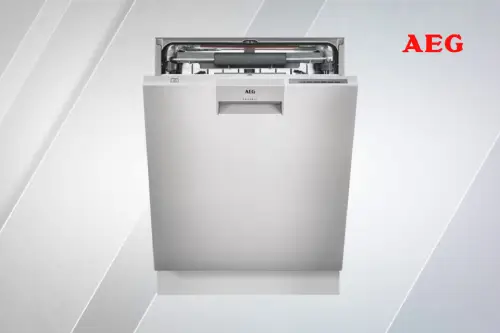
| Code | AEG's published meaning | Checked first |
|---|---|---|
| i10, i11, AL5, C1 | Water inlet problem | Scale in the tap-end connector filter. On a new install, the blanking plug left in the sink trap |
| i20, C2, F2, AL6 | Draining problem | Filters and sump, then the drain height, which AEG specifies at 40 to 85 cm |
| i30 | Water leak detected in the base | The anti-flood float. The field signature is a drain pump that hums continuously on its own |
| i40, i43, i44 | Pressure sensor problem | The sensor hose and chamber before the sensor itself |
| i50 | Wash motor or pump malfunction | Debris jamming the impeller before condemning the motor |
| i60, i61, i69, i6C | Water too hot, or temperature sensor fault | Whether it is plumbed to hot fill. AEG caps inlet water at 60°C at the connection |
| iF0, iF1 | Water level problem | Fill and drain behaviour across a full cycle |
An i30 deserves its own note because it is the one that produces repeat visits. AEG's own instruction is to disconnect power overnight with the tap closed so the base tray dries, then retest. The code will clear. If the water that reached the base has not been traced, it comes back, which is why we look for the source rather than resetting the machine and leaving. See also our dishwasher repair page and the guide to a dishwasher that will not drain.
AEG Oven and Range Repair, and the Published F-Codes
Here is something no competing AEG page will tell you. AEG publishes roughly 75 oven F-codes and gives a meaning for only three of them. Its own F-code index lists F14, F15, F22, F24, F31 through F38, F101 through F138, F321 through F329 and dozens more, then states that these faults require a specialist engineer to investigate. No definitions are given.
Any site showing you a full AEG oven code table with a tidy meaning against every code did not get it from AEG. We would rather tell you the honest position: on most F-codes the code narrows the area, and the diagnosis is done with a meter on the appliance, not from a lookup table.
The three AEG does define are worth knowing.
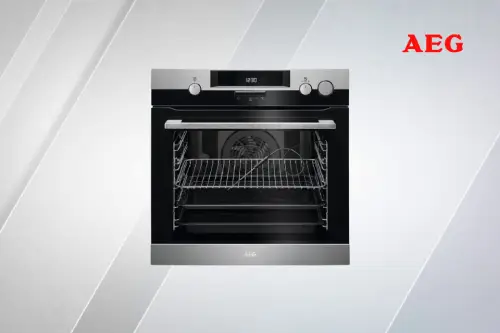
| Code | AEG's published meaning | Checked first |
|---|---|---|
| F1 on a pyrolytic oven | The door cannot close while the pyrolytic function is on | The top edge of the door, and the reassembly if the door was taken off for cleaning |
| F1 on a non-pyrolytic oven | An electronic fault | The control board. Same code, different appliance, different repair |
| F11, F111 | Food probe faulty or not connected correctly | The probe plug seated fully in the socket, and the contacts for damage |
| F102 | Door lock defect, or an electronics fault | The latch motor and its switch before the board |
The F1 split is the practical one. Our first question on an F1 call is whether the oven is pyrolytic, because a BP-series cabinet is self-cleaning and a BE-series one is not, and the answer sends the visit in two different directions. AEG documents this on its oven F1 support article. More on oven repair and stove repair.
AEG Refrigerator Repair
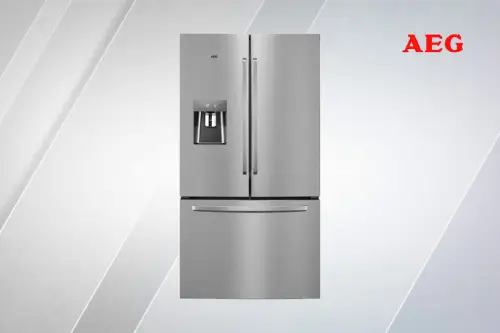
The Canadian AEG refrigeration line is the ARCTIS series: ARCTIS-30, ARCTIS-30IW and ARCTIS-36IW, panel-ready bottom-freezer cabinets. Being integrated matters to the job. The door panel and cabinet furniture come off before the technician reaches anything, so a fifteen minute component swap on a freestanding fridge is a longer visit on one of these.
AEG does document cooling fault codes, which surprises owners who have been told fridges have none.
| Code | AEG's published meaning |
|---|---|
| F3, F4, F5 | Temperature sensor faulty or not working correctly, so the cabinet cannot hold temperature |
| E01, E02, E03, E06, E07 | Sensor warning |
A sensor code is good news relative to what owners fear. It points at a thermistor and its wiring rather than the sealed circuit, and it is a parts-and-labour repair on a cabinet worth keeping. AEG marks these as authorised-service work and no self-repair, which we agree with on an integrated cabinet. If the diagnosis does reach the sealed circuit, that is Ozone Depletion Prevention certified work in Ontario. Related reading: fridge repair, a freezer that stays cold while the fridge warms, and freezer repair.
AEG Induction and Electric Cooktop Repair
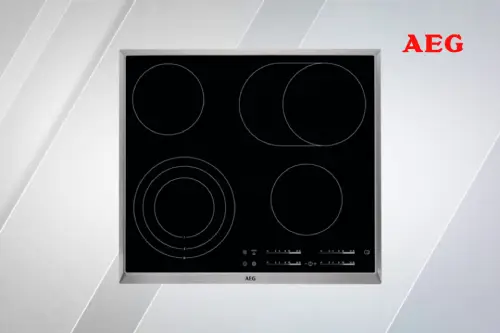
The Canadian cooktops split into two families. IKE is induction, the IKE6401BT and IKE8401BT, and HK is electric, the HK6400BT and HK955070FB. Induction generates most of the service calls, and a useful share of them are not faults at all.
AEG makes one distinction on induction hobs that decides the whole visit. A constant F on a hob that has just been installed points at the installation or the supply connection, and the right call is the installer who wired it. A flashing F on a hob that has worked for years is cookware detection: the pan base is not ferrous, or it is too small for the zone. A fridge magnet on the pan base answers that in three seconds. A U means the zone has not registered any cookware at all.
The E-codes are firmer. E0, E1, E011, E012 and E013 are an electronics fault, and AEG's reset is to isolate the hob for at least 30 seconds at the breaker rather than at a plug, since these are built in. The whole E4 family, E401 through E433, is the overheating protection doing its job. That usually traces back to clearance and ventilation under the hob rather than to the hob itself, which is why we ask what is in the cabinet underneath.
AEG Washer Repair
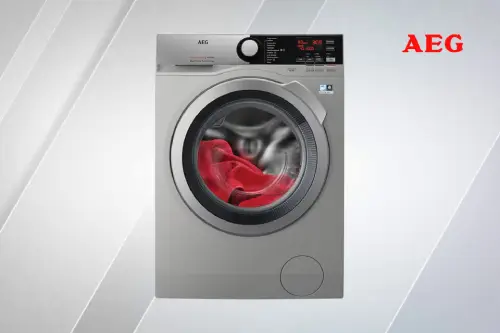
Most AEG washers we are called to are European imports rather than the thin Canadian line, so the voltage question above applies before anything else. The codes are the same either way.
AEG runs the E-series: E10 or E11 water supply, E20 or E21 draining, E30 water pressure sensor, E40 door lock, E50 motor, E60 heating, E70 temperature sensor, E90 through E94 configuration and communication, EF0 leak, foam or an unbalanced load. On an older generation the same faults show as C1 and C2, and on a machine with no display they are counted out: E10 is one beep or one flash, E20 is two, E40 is four, EF0 is fifteen.
One code we tell people to call an electrician about instead of us. EH0 is a power supply fault, and AEG splits it three ways: EH1 the supply frequency out of range, EH2 the voltage too high, EH3 the voltage too low. AEG also warns against running these machines on an extension cable. That is a house wiring problem, and replacing parts in the washer will not touch it.
More on washer repair and a front load washer that will not spin.
AEG Dryer Repair, Including Heat Pump Models
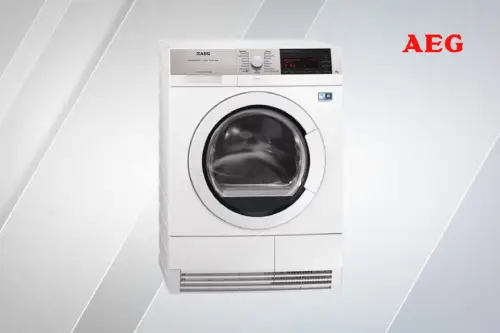
A heat pump dryer that has slowed down is usually a maintenance problem, and it is worth checking before you book. AEG's published schedule is the fluff filter after every cycle and the condenser inspected at least once a month or when the condenser indicator flashes.
Correcting a claim we hear often: AEG does not say heat pump condensers are self-cleaning. Its manual warns against running the dryer with a condenser blocked by fluff because it damages the machine. On heat pump models the condenser is cleaned in place through a cover with a single lever, using a damp cloth or a vacuum with a brush. On a conventional condenser dryer the unit comes out horizontally and is rinsed over a basin. Two different procedures, and doing the wrong one gets you nowhere.
On codes: E60 is a heating source problem, and AEG's guidance here is unusually installation-led. It specifies a room over 10 to 12 square metres with good ventilation and warns against installing in an unventilated cabinet. Its confirmation test is a timed program of about 30 minutes; still no heat means a service call. E40 and E45 are door closure, E20 drainage or pump, and E9E electrical noise or humidity on the user interface board.
Err is not a breakdown. It appears when a cycle or option is changed after the program has started, or when two incompatible options are selected. It applies to vented, condenser and heat pump models alike. See electric dryer repair and a dryer that takes too long.
AEG Rangehood and Ventilation Repair
The PERFEKT range is the Canadian ventilation line: GLIDE, INSERT and PYRAMID in 24, 30 and 36 inch widths, plus the RP369 and RI489. These are simpler machines than the rest of the lineup and the faults reflect that. A hood that will not start is usually the control panel or its ribbon connection; a hood that runs on one speed only is the speed selector; a hood that has become loud is the blower bearing or a fan wheel loaded with grease. Filters and lamps we replace on the spot where the part is a stock item.
How an AEG Fault Is Actually Diagnosed
AEG's consumer support articles stop at the code and tell you to call an authorised service centre. The numbers a technician works to come from the Electrolux service documentation behind the brand, which is a different publication entirely. For the ENV06 and EWM2100 laundry control platforms, Electrolux service manual 599 70 56-70 sets out both the test mode and the component values.
Entering diagnostic mode on a standard machine means holding START/PAUSE and the adjacent option button together, then turning the programme selector one position clockwise while still holding both, until the LEDs flash after about two seconds. That gives the technician the control's own fault memory rather than the single code on the display.
The component figures are what separate a diagnosis from a guess. On these platforms the wash NTC sensor should read 5.7 to 6.3 kΩ at 20°C and the drying duct NTC 4.7 to 5.3 kΩ at the same temperature. A 230V 1950W heating element reads 26 to 28 Ω, the drain pump 155 to 200 Ω, and the water fill solenoid 3.5 to 4.5 kΩ. An E70 with a sensor measuring 2 kΩ is a failed thermistor. An E70 with a sensor reading 6 kΩ is a wiring or connector fault, and swapping the sensor would have wasted your money.
There is a second trap here worth naming. The service manual uses a finer code set than the display does. Your machine shows E20; the service manual separates E21 difficulties draining, E22 draining during drying, E23 drain pump triac faulty and E24 a fault in the triac sensing circuit. Those service codes are not what appears on your panel, and a page presenting them as consumer codes is misreading its own source.
Is Your AEG Serviceable in Canada, and How Long Do Parts Take
Worth reading once you know what the fault is, because on this brand the answer to "can it be fixed" often turns on supply rather than diagnosis. AEG is a dealer brand here, imported by Euro-Line Appliances of Oakville, Ontario, with parts and warranty through Euro-Parts Canada. Appliances bought new in Canada carry a two year parts and labour manufacturer warranty through that channel.
| Category | Canadian model examples | Parts outlook |
|---|---|---|
| Wall ovens | BEK230010M, BEK431010M, BPK754110M, BSK892330M | Good. The core Canadian line |
| Dishwashers | F8242FI, F8242FI-18, F8642FI, F89088VI-M-1 | Good, including the 18 inch |
| Cooktops | IKE6401BT, IKE8401BT induction; HK6400BT, HK955070FB electric | Good |
| Refrigeration | ARCTIS-30, ARCTIS-30IW, ARCTIS-36IW | Available. A narrow, panel-ready line |
| Ventilation | PERFEKT GLIDE, INSERT and PYRAMID, RP369, RI489 | Good |
| Warming drawers | WD60-29, WD60-14 II, WD76-25 | WD is a warming drawer here, not a washer dryer. Parts counters get this wrong |
| Laundry | L71400 washer, DC240 dryer | Thin and largely legacy. Most AEG laundry here is a European import, and that is where waits get long |
Two things circulate widely and both are wrong. AEG refrigeration is sold in Canada, as the ARCTIS cabinets, so a Canadian AEG fridge is a normal serviceable appliance. Laundry runs the other way and is the category most likely to be an import.
The rating plate settles which you have. AEG built for Canada is a 60 hertz product: the RDF36 range is specified at 120/240V, 60Hz, the F8242FI-18 dishwasher at 120V, 60Hz, 12A, the WD60-29 warming drawer at 220V, 60Hz, 15A, with the North American oven manual calling for installation to CSA Standard C22.1. European AEG runs at 230 to 240V, 50Hz, which is what AEG's own UK pages list for the LFX50942B washer and TR818P4B dryer. We will still look at an imported machine, and we tell you before the visit that a transformer changes the voltage but not the frequency.
Give us the PNC and the wait gets shorter. The rating plate carries four identifiers and only one orders parts: model code, PNC, ML code and serial number. AEG's own worked example is model EWF12040W with PNC 914520402 and ML 05. A model code often returns several builds; the PNC returns one.
Why the lead times exist at all: Reliable Parts Canada, the largest appliance parts distributor in the country, does not carry AEG. Its brand list runs Electrolux, Frigidaire, Gibson, Kelvinator, Tappan and Westinghouse with no AEG entry, so an AEG part is a Euro-Parts order rather than an afternoon pickup. What works in your favour is the Electrolux parentage, since Electrolux bought AEG's appliance division in 1994 and the platforms are shared. One genuine 2400W fan oven element, part 3878684103, is catalogued as fitting AEG ovens in the BP, BE and BC families and Electrolux ovens including the North American EI24EW35LS and EI24EW45LS. When an AEG-badged part is slow, our technician checks whether an Electrolux equivalent is the same component before anyone waits six weeks.
We have technicians based in eight regions rather than dispatched from one hub: the GTA, Barrie, London and Ottawa in Ontario, Vancouver in British Columbia, Winnipeg in Manitoba, Halifax in Nova Scotia, and New York City. Each has its own local number. Because AEG is a dealer brand concentrated in urban markets, most of the AEG work we see is in the Toronto and Vancouver areas, but the coverage is not limited to them. The service areas page lists the city nearest you and the number to call there.


