
 Refrigerator Repair
 Dishwasher Repair
 Washer Repair
 Electric Dryer Repair
 Oven Repair
 Stove/Cooktop Repair
 Freezer Repair
 GAS Appliance Repair
 Appliance Installation
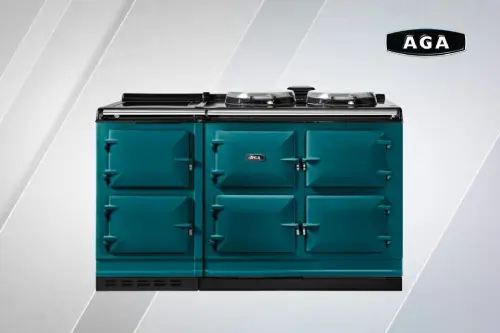
AGA Appliance Repair
We repair electric and induction AGA cookers: the eR7, eR3, R3, R7, Total Control, AGA 60 and ERA, plus AGA dishwashers, induction rangetops and refrigeration. An AGA is a cast-iron heat storage appliance, so the diagnosis and the access are different from a conventional range. Labour runs $92 to $278, and the service call is free with the repair.
Your Local Appliance Repair Company
- Experienced technicians
- Manufacturer parts where they are available
- Convenient Scheduling
- Prompt Service
- Diagnosis at your address
- Quoted before work starts
- Warranty up to 3 months
- Transparent Pricing

Article Reviewed & Technically Verified by Dmitriy D., Lead Appliance Repair Technician, ODP-Certified (15+ Years Experience)






Find Your AGA Fault
Start with the appliance and what it is doing. Most AGA faults arrive with no code at all, so the code column is the last one rather than the first. Where a code does exist it applies to the eR7 and R7 cookers, the only AGA models with a published code set.
| Appliance | What it is doing | On an AGA this is usually | Code, if any |
|---|---|---|---|
| Fridge | Running constantly but not getting cold | The defrost circuit or the evaporator fan long before the compressor. Owners fear the worst here and are usually wrong | none published |
| Fridge | Freezer still cold, fresh food warm | Frost blocking the evaporator so air stops moving between the compartments | none published |
| Fridge | Water pooling under the crisper drawers | A blocked defrost drain, which is a clearing job rather than a parts job | none published |
| Fridge | Newly noisy | The evaporator fan motor or its blade catching on ice | none published |
| Dishwasher | Water left standing in the tub | Filter and sump, then the drain pump and the hose loop under the sink | none published |
| Dishwasher | Not filling | The inlet valve or a scaled tap-end filter | none published |
| Dishwasher | Dishes coming out gritty | A blocked spray arm or the wash impeller rather than a failing pump | none published |
| Induction hob | One zone will not heat | The pan. Hold a fridge magnet to the base, and if it does not stick the hob is behaving correctly | none published |
| Induction hob | A whole side of the hob dead | One generator board rather than several coils | none published |
| Rangehood | Will not start, or runs on one speed only | The control panel and its ribbon connection, or the speed selector | none published |
| Cooker | One oven cold, the others still working | That oven's element or its thermocouple. Elements read 18 to 22 ohms, so this is a quick measurement | 130 to 136, or 060 to 100 |
| Cooker | Oven running hot, food catching | A drifting thermocouple. These test correctly at room temperature and drift once hot, which is why the fault is intermittent | 020 to 024 |
| Cooker | The wrong oven heats up | Thermocouples cross connected at the back of the control panel, usually after previous work | 120 to 124 |
| Cooker | Hotplate cold, ovens fine | The boiling and simmering plates share one 2.5 kW circular element, part AE4M281314 | 130 to 136 |
| Cooker | Runs at full power and never settles | A thermocouple sitting out of position, so the control never sees target temperature | 010 to 014 |
| Cooker | Slower to reach heat than it used to be | Door seals or degraded insulation letting stored heat escape | often none |
| Cooker | Control panel far too hot to touch | A door seal, a door not closing properly, or something draped over the control panel door | 139 |
| Cooker | Handset will not talk to the cooker | The RF receiver rather than the handset itself | 159 |
| Cooker | Touch panel frozen, or lit but doing nothing | The touch panel microcontroller, or the communications cable to the main board | FE, CE |
| Cooker | Dead after an electrical supply change | The configuration key missing, or the wrong key for the phase of the supply | 140 |
| Cooker | Handset shows something like n 3.11 or n 133 | A Total Control code. Write it down exactly, including the point. Rewriting it as E3 or F11 destroys the information | not published |
No code and nothing in the table? That is the normal case on this brand, and it is not a problem. Tell us the appliance, what it does, and when it started, and we will tell you what it usually turns out to be before anyone is dispatched. Deciding whether the repair is worth doing is a separate question, and our guides on repairing or replacing a refrigerator, a dishwasher and an oven set out how we weigh it.
What AGA Makes, and What It Does Not
Worth clearing up first, because it sends people to the wrong page. AGA has never made washing machines or dryers. No laundry appliance appears in AGA's product range, in the century of company history AGA publishes, or in the parent group's brand portfolio. If you are looking for laundry service, our washer repair and dryer repair pages cover the brands that do make them.
What AGA does make, and what we book, are the electric and induction models below.
| Type | Models we service | What it is |
|---|---|---|
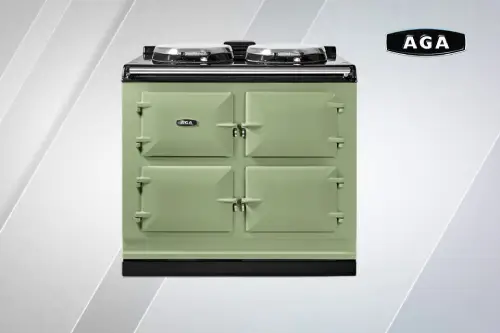
| Cast-iron heat storage cookers | eR7 (AER7339), R7 Classic, eR3 Compact, R3 Series, Signature, AGA 60 Electric, Total Control ATC3, 13-amp EC-LM and EE-LM | The traditional AGA. All-electric versions |
| Conventional and hybrid ranges | ERA 44 (AERA44INS), Elise induction, Mercury induction, Masterchef Deluxe induction | Instant-control ranges wearing the AGA badge |
| Induction cooktops and rangetops | AMC36INRTSS and the AGA induction hob range | Glass-top induction, no cast iron involved |
| Dishwashers | Elise AELTTDW, Legacy ALTTDW, ADW-24 | 24 inch built-ins, AGA-badged |
| Refrigeration | Legacy AFHR-36 and AGA-badged cabinets | Separate from Marvel, which is its own brand |
| Ventilation | ARHD-36, ARHD-48 and AGA hoods | Range hoods matched to the cookers |
AGA does not make wall ovens or microwaves either, so if you have a built-in oven with an AGA-style look it is worth checking the data plate before booking. The models heated by gas sit outside what we take, and the plate will tell you which you have in one line.
AGA Cooker Repair
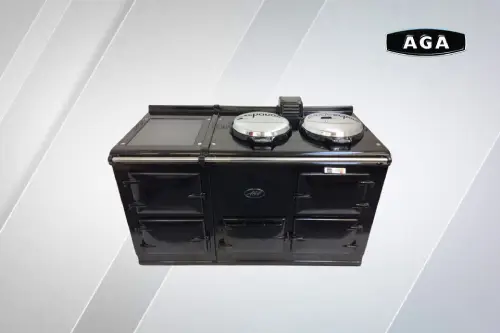
An AGA is a heat storage appliance, and almost every difference in how it is repaired follows from that. AGA describes the principle in its own words: heat "is transferred to the cast-iron heat storage ovens, releasing steadily from all surfaces simultaneously," rather than the direct heat of a conventional cooker. The ovens hold fixed temperatures instead of taking a dial setting. On a Total Control ATC3 the roasting oven sits at roughly 425 to 475°F, baking at 325 to 375°F and slow cook at 212 to 245°F, with the boiling plate at 626°F.
That design changes what a fault looks like. A conventional oven that loses its element goes cold in minutes. An AGA coasts on stored heat, so the owner often reports that dinner took longer, then that one oven felt cooler, and only later that something is wrong. By the time we are called the cooker may have been running on a dead element for a week.
It also changes how long a repair takes to prove. A Total Control takes about 35 minutes to bring the roasting oven up from cold and 22 for the baking oven, while a traditional cast-iron AGA needs hours to saturate the castings. Our technician cannot swap an element and see the result in two minutes on this appliance. Related: oven repair, stove and cooktop repair, and what a noisy oven usually turns out to be.
eR7 and R7 Fault Codes
Most sites will tell you AGA publishes no fault codes. That is true of the owner manuals, and it is where our earlier version of this page stopped. It is not true of AGA's field service documentation: the AGA eR7 Field Service Manual for the USA and Canada carries a full code table. These are the codes, with AGA's own descriptions.
| Code | AGA's description | What it means on site |
|---|---|---|
| 002, 003, 006 | Communication watchdog fault | The COMS cable and its connections first. The board only after it recurs |
| 007 | Thermocouple reference fault | The panel cannot process thermocouple readings at all |
| 010 to 014 | Full power time out | Thermocouple position, and sometimes how the cooker is being used |
| 020 to 024 | Thermocouple differential | Exchange the thermocouple. This is the drift fault |
| 060 to 100 | Thermocouple open circuit | Tested across the green and white conductors before replacement |
| 110 to 116, 150 to 156 | Relay short or open circuit | Logged and reset. A repeat points at the main board |
| 120 to 124 | Cooking zone overheat | Thermocouples cross connected on the user control |
| 130 to 136 | Triac fault | Element connections and resistance, 18 to 20 ohms, before the board is condemned |
| 139 | User panel overheat | Door seals, a door left open, missing insulation, or towels over the panel door |
| 140 | Configuration key fault | No key fitted, or the wrong key for the phase of the electrical supply |
| 159 | Handset RF fault | The receiver is not communicating with the board |
| FE | Touch panel microcontroller unresponsive | A reboot may clear it |
| CE | No response from main controller | Connection and condition of the COMS cable |
Codes 004 and 005 are listed as not used. Note how many of these rows point away from the expensive part: 120 to 124 is wiring done wrong on a previous visit, 139 is a door seal, 140 is a missing key, and 130 to 136 asks for a resistance check before anyone orders a board.
Total Control and the n.nn Code
Total Control cookers report faults differently, and here the honest answer is that AGA publishes the format but not the meanings. Its user guides say a code "may be displayed on your handset, for example: n 3.11" and instruct the owner to pass that number to AGA Service. Another guide gives "n 133". No table assigns meanings to these, and we have not found one.
So if your handset is showing one: copy it exactly, including the point. A number such as 3.11 carries information. Rewritten as E3 or F11 it carries none, and that is the most common way the diagnosis gets lost between the kitchen and the phone call. Tell us the number, what the cooker did before it appeared, and when it was last serviced.
AGA Induction Cooktop and Rangetop Repair
The induction side of the AGA range has nothing in common with the cast-iron cookers mechanically. The AMC36INRTSS rangetop draws 240V at 50A through a NEMA 14-50 connection for 11.4 kW across five zones, and the ERA 44 runs 240V at 32A for 7 kW. These are power-hungry appliances, and a zone that has stopped working is as often a supply or connection question as a failed generator board.
Before you book, two checks cost nothing. Hold a fridge magnet to the base of the pan: if it does not stick, the pan will not work on induction and the hob is behaving correctly. Then check whether the zone failed alone or with others, because a whole side going down points at one generator board rather than individual coils. Our cooktop repair page covers the induction faults we see across brands.
AGA Dishwasher Repair
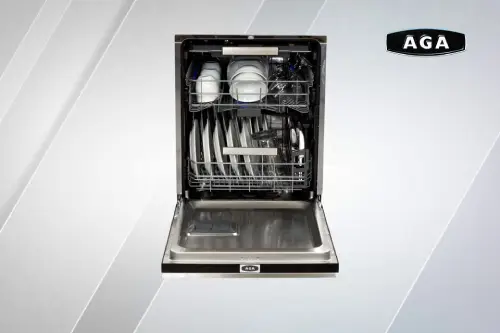
AGA dishwashers are 24 inch built-ins: the Elise AELTTDW, the Legacy ALTTDW and the ADW-24 with its matching ADWP-24 panel. They are conventional machines behind an AGA-styled door, so the faults are the ordinary ones: not draining, not filling, poor wash results, leaks and door seals.
The AGA-specific complication is the door. These are panel-ready units built to match a cast-iron cooker, and the custom panel and its mounting come off before the technician reaches the door mechanism. It is worth knowing that before you are quoted, because it is labour a standard dishwasher does not carry. Our general dishwasher repair page covers the mechanical side, and drainage faults and a machine that will not fill are set out separately. If the panel has been off before, our dishwasher installation page explains how these are fitted.
AGA Refrigeration Repair
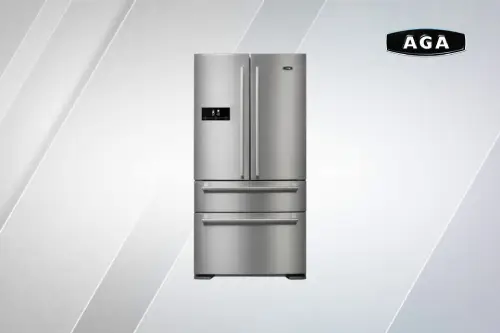
AGA-badged refrigeration exists and we service it, the Legacy AFHR-36 bottom-mount among them, a 36 inch 20 cubic foot cabinet. One point of confusion worth settling: Marvel is a different brand from AGA, with its own product line of beverage centres, wine cabinets, ice machines and undercounter refrigeration. The two shared a North American operating company for years, which is why "AGA Marvel" appears on parts listings, but a Marvel unit is not an AGA unit and the parts catalogues differ.
Faults are the standard refrigeration set: defrost circuit, evaporator fan, door seals, control board. Where the diagnosis reaches the sealed circuit, that work requires an Ozone Depletion Prevention certificate in Ontario. See also fridge repair and a freezer that stays cold while the fridge warms, freezer repair, a fridge that will not defrost, and cleaning the condenser coils, which prevents a fair number of these calls.
AGA Rangehood and Ventilation Repair
The PERFEKT range is the Canadian ventilation line: GLIDE, INSERT and PYRAMID in 24, 30 and 36 inch widths, plus the RP369 and RI489. These are simpler machines than the rest of the lineup and the faults reflect that. A hood that will not start is usually the control panel or its ribbon connection. A hood stuck on one speed is the speed selector. A hood that has become loud is the blower bearing, or a fan wheel loaded with grease and out of balance, which is worth cleaning before anyone quotes you a motor.
Filters and lamps we replace on the spot where the part is a stock item. See range hood repair for the work we do across brands.
How an Electric AGA Is Diagnosed
The numbers our technician works to come from AGA's field service documentation rather than the owner's guide, and they are what separate a diagnosis from a parts swap on this brand.
Elements. On the eR7 the boiling plate, the simmering plate and the ovens all use a 2.5 kW element, circular for the plates and rectangular for the ovens, and every one of them should measure roughly 18 to 22 ohms. An open circuit means the element. A correct reading with the fault still present sends the technician to the board, not to another element.
Thermocouples, not thermostats. An electric AGA senses temperature with thermocouples, tested across the green and white conductors. The failure mode worth understanding is drift: AGA's own service manual notes that returned thermocouples "test ok at room temp but drift" once hot. That is why an oven can pass a cold bench test and still ruin your baking, and why a technician who only measures cold will tell you nothing is wrong.
Parts. The recurring items on the eR7 are the Tekelek PCB AE4M280812, the touch control unit AE4M281316, the boiling and simmer plate element AE4M281314, the oven element AE4M280036, the top plate rope seal AE4M233717, the thermocouple AE4M280732 and the customer handset AE4M280526. In North America these come through the authorised AGA Marvel parts channel rather than a general parts counter.
What AGA's Service Schedule Actually Says
Owners are often told an AGA needs annual servicing. For the electric models that is mostly wrong, and AGA publishes the intervals itself in its customer support FAQ.
| Model | AGA's published interval |
|---|---|
| eR3, R3, eR7, R7 | No regular servicing required |
| Electric Total Control | Interim check at 2.5 years, full service at 5 years |
| 13-amp electric, EC-LM and EE-LM | Every 5 years |
One inconsistency worth flagging rather than hiding: AGA's FAQ lists the electric AGA 60 as needing no regular servicing, while the AGA 60 Electric manual specifies a 30 month interim and a 60 month full service. We follow the manual for your specific model, since that is the document written for the machine in your kitchen.
Weight, Access and What the Visit Involves
This is the part owners are least prepared for. A Total Control ATC3 weighs 816 lb as a product and 1,135 lb crated. A traditional four oven AGA is 584 kg, near 1,287 lb. Even the small AGA 60 Electric is 492 lb, and the eR3 90 is 300 kg.
Three consequences follow. AGA's own specification calls for 39.5 inches of clearance at the front so the range can be serviced, so a kitchen island installed tight to the cooker turns a routine job into a much longer one. The floor has to be level front to back, side to side and diagonally, and AGA asks owners to confirm the floor supports the weight. And the cast iron holds heat for hours after the supply is isolated, so a technician cannot switch off and start work immediately.
We tell you which of these apply when you describe your kitchen on the phone, because on this appliance they change the length of the visit more than the fault does.
AGA Care, Warranty and Who May Work on Your Cooker
We would rather you hear this from us than find out afterwards. AGA states in its manuals that the appliance "must only be serviced by a qualified engineer, from an authorized AGA Specialist," and the AGA Care terms exclude "any issue caused by any work carried out on your AGA Cooker by any person other than an AGA Engineer."
So if your cooker is still under AGA warranty or covered by AGA Care, call AGA first. In North America AGA diagnoses and then arranges one of its approved service companies. Using an independent company on a covered appliance can affect that cover, and no repair we do is worth costing you a warranty.
Where we are useful is everything outside that: cookers out of warranty and off AGA Care, second-hand AGAs bought with a house, appliances where the owner wants a diagnosis and a price before deciding, and the ordinary dishwasher, refrigeration and hood work that sits alongside the cooker. We are an independent repair company rather than an AGA-appointed specialist, and we say so plainly.
We have technicians based in eight regions rather than dispatched from one hub: the GTA, Barrie, London and Ottawa in Ontario, Vancouver in British Columbia, Winnipeg in Manitoba, Halifax in Nova Scotia, and New York City. Each has its own local number. AGA is a low-volume brand in Canada, sold through a handful of specialist dealers, so tell us your model when you call and we will be straight with you about parts before we book. The service areas page lists the number nearest you.


