
 Refrigerator Repair
 Dishwasher Repair
 Washer Repair
 Electric Dryer Repair
 Oven Repair
 Stove/Cooktop Repair
 Freezer Repair
 GAS Appliance Repair
 Appliance Installation
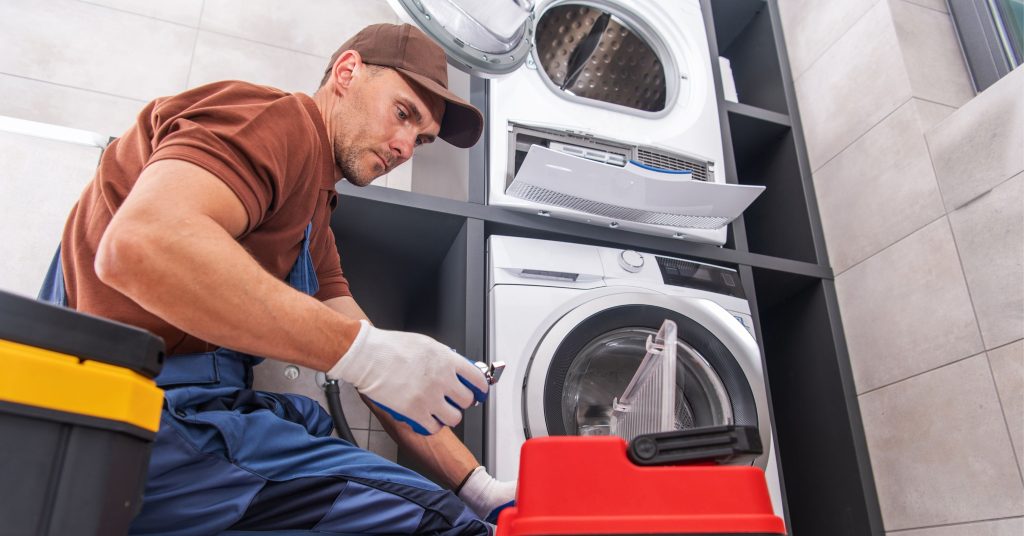
Avanti Appliance Repair
We repair Avanti compact refrigerators, wine and beverage coolers, freezers, dishwashers, compact washers and dryers, and 20 and 24 inch electric ranges. Avanti's own warranty says it does not apply outside the continental USA, so a Canadian owner has no factory coverage to fall back on. Labour runs $92 to $278, and the service call is free with the repair.
Your Local Appliance Repair Company
- Experienced technicians
- Sealed system work by an ODP-certified tech
- Diagnosis at your address
- Quoted before work starts
- Warranty up to 3 months
- Convenient scheduling
- Prompt service
- Transparent pricing

Article Reviewed & Technically Verified by Dmitriy D., Lead Appliance Repair Technician, ODP-Certified (15+ Years Experience)






Find Your Avanti Fault
Start with the appliance and what it is doing. Avanti publishes no single code list across its range, and its refrigerator, freezer, dryer and range manuals carry no code table at all, so most of what we are called out to shows nothing on a display. The code column is last for that reason.
| Appliance | What it is doing | What it usually is | Code, if any |
|---|---|---|---|
| Compact fridge | Warm inside, but the light works and it hums | The dial may simply be at 0, which stops cooling without powering the unit off. After that, the door gasket and the condenser coil at the back | none |
| Compact fridge | Not cooling at all | Where the unit stands matters. Avanti specifies a room between 16°C and 32°C, so a garage or an unheated basement in winter is outside spec | none |
| Compact fridge | Thick ice in the small freezer box | Normal. These are manual defrost. Avanti says to defrost when frost reaches about 5 mm and never to scrape it with a knife | none |
| Compact fridge | Ice cream will not stay hard | By design. Avanti states the chiller compartment is not a true freezer and may not keep ice cream frozen | none |
| Compact fridge | Water pooling inside or under it | A blocked defrost drain, or condensation from a gasket that has stopped sealing. Also check the unit is level | none |
| Compact fridge | Runs constantly | Door seal, over-packed shelves, or a condenser coil furred with dust. These sit in tight spaces and choke easily | none |
| Wine cooler | Not reaching the set temperature | Room temperature, door seal and the fan first. On a full cabinet, restricted airflow around the bottles | E1 to E4 if a sensor has failed |
| Wine cooler | Display shows E1 or E2 | A temperature sensor fault. On this product family only, and not the same as E1 on an Avanti washer | E1, E2 |
| Wine cooler | Display shows E3 or E4 | A defrost sensor fault | E3, E4 |
| Wine cooler | Display shows HH or LL | A high or low cabinet temperature alarm. The trigger point differs between models | HH, LL |
| Wine cooler | Condensation on the glass door | Humid room air meeting cold glass. Common in a Canadian basement in summer, and not a fault | none |
| Wine cooler | Buzzing or gurgling | Refrigerant moving. Avanti calls this normal in its own manuals | none |
| Freezer | Running warm, contents softening | Lid or door gasket first, then the thermostat. A chest freezer in a cold room can also stop cycling correctly | none |
| Freezer | Heavy frost on the walls | Manual defrost models frost by design. If it returns within days, suspect the lid seal | none |
| Dishwasher | Water left standing in the tub | Filters and the drain hose before the pump. Avanti also asks whether the sink itself is draining | F2 |
| Dishwasher | Water on the floor | Overfilled rinse aid causes foam that reads as a leak. After that, the door seal and levelling | F1, F3 |
| Dishwasher | Dishes coming out wet | Rinse aid, then the heating circuit | F6, F8 |
| Dishwasher | Stops and shows an F code | See the F table further down. Several of them are stop-and-call-us faults rather than owner fixes | F1 to F9, FF, FE, HI |
| Washer | Fills slowly or not at all | The tap, the inlet screen, or a kinked hose. A hose left outdoors in winter can freeze | E1 |
| Washer | Will not start a cycle | On top loaders, the lid has to be shut. This is the single most common call we take on these | E2 |
| Washer | Stops mid-cycle and beeps | Usually an unbalanced load. Redistribute and restart before booking | E3 |
| Washer | Will not drain or spin | Drain hose squashed or bent, then the pump | E4 |
| Washer | Walking or banging | Levelling. Avanti is explicit that these need levelling to work properly, and portables on a kitchen floor rarely are | none |
| Washer | Leaking underneath | Hose connections at the tap and at the machine first, since portables get connected and disconnected constantly | none |
| Dryer | Tumbles but does not heat | Element, thermostat or thermal fuse. Avanti compact dryers publish no code table, so this is diagnosed by measurement | none |
| Dryer | Takes several cycles to dry | Lint filter and the exhaust run. These are small machines with little reserve, so a partly blocked duct shows up quickly | none |
| Dryer | Burning smell | Stop using it. Lint against the heater is a fire risk on any dryer, compact included | none |
| Range | One surface element will not heat | The element or its receptacle. Burnt contacts are common where something has boiled over | none |
| Range | Oven runs hot or cold | The oven sensor and its connector before the board. These ranges carry no code display | none |
| Range | Oven will not heat at all | The bake element, then the thermostat or control. Check the breaker first, since a 240V range can lose one leg and still light up | none |
| Compact fridge | A new rattling or loud buzzing | Often the compressor mounts or something touching the cabinet. Gurgling from the back is refrigerant and normal | none |
| Washer | Stops part way through a cycle | A fill or drain step it never completed. Check the tap, the inlet screen and the drain hose before booking | E1, E4 |
| Washer | Grinding noise while spinning | Something in the pump or a worn bearing. Stop using it before the drum damages the seal | none |
| Washer | Lid or door will not open | On front loaders the interlock holds until the drum stops and the water is out. If it stays locked, the lock or the drain is the fault | E6 |
| Dishwasher | Stops part way and shows a code | Read the F table below. FF and F2 have owner checks, the rest are stop-and-call faults | FF, F2, others |
| Dishwasher | Door will not close or latch | The catch, or racks pushed forward. A door that will not latch stops the cycle before it starts | none |
| Dryer | Stops part way and will not restart until it cools | The thermal cut-out doing its job. The lint filter and exhaust run are the cause | none |
| Dryer | Rumbling or squealing | Drum rollers, idler and belt, replaced together because the cabinet only comes apart once | none |
| Range | Oven door locked shut after cleaning | Let it cool fully first, since many release on their own. After that the latch motor and its switch | none |
| Any | Dead, nothing at all | The outlet and the breaker before anything inside. Portables and compacts get moved, and cords get pinched | none |
Leaking right now? Unplug the appliance, close the tap behind a washer or dishwasher, and call us rather than running another cycle. On a compact fridge or wine cooler, water inside the cabinet is usually a blocked drain rather than a failed sealed system, and that is a clearing job rather than a replacement.
Avanti Refrigerator Repair
Compact and apartment-size refrigeration is what Avanti is built around, and three of its design choices account for most of the calls we take. The first is the temperature dial. Turning it to 0 stops the cooling without switching the unit off, so the light still comes on and the fan still runs while the cabinet warms up. We have arrived to fridges that needed nothing but the dial moved.
The second is the chiller compartment. Avanti states plainly in its own manual that it "is not a true freezer, and may not keep ice cream frozen," and that it is meant for ice cubes and three to four days of storage. Soft ice cream in that box is the appliance working as designed.
The third is placement. Avanti specifies a room above 60°F (16°C) and below 90°F (32°C). An Avanti in a Canadian garage, a cold basement or a hot sunroom is being asked to do something outside its rating, and it will run badly there whatever we replace. We will tell you that rather than sell you a thermostat.
Beyond those, the real faults are ordinary: a door gasket that has stopped sealing, a condenser coil packed with dust because the cabinet sits in a tight cupboard, a blocked defrost drain leaving water under the crisper. A compact fridge that runs constantly is usually telling you about one of those three rather than about the compressor, and if you are unsure what the dial should be set to, our guide to the right fridge and freezer temperatures covers it. Labour runs $92 to $278, and the service call is free with the repair.
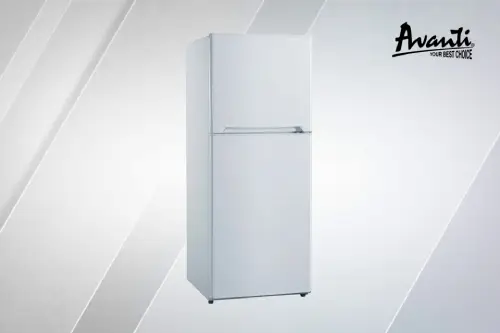
Avanti Wine Cooler and Beverage Centre Repair
Wine and beverage cabinets are the one Avanti product family that does publish error codes, and the list is short:
- E1 and E2 report a temperature sensor failure.
- E3 and E4 report a defrost sensor failure.
- HH is a high cabinet temperature alarm, LL a low one. The trigger points are not the same on every model: one Avanti cabinet alarms above 78.8°F, another not until 99°F, so read your own manual before assuming the number.
A sensor is a cheap part and a short job, and it is the same repair we do on other wine cabinet makes such as Cavavin, Marvel and AVG. What takes longer is the cooler that holds a temperature several degrees above its setting with no code showing at all. That one is about the room, the door seal and airflow. A cabinet packed to capacity with no gap between bottles cannot circulate, and the top shelf ends up warmer than the bottom regardless of what the display says.
Condensation on the outside of the glass is not a fault. It is humid room air meeting cold glass, and in a Canadian basement in August it is close to unavoidable. Buzzing and gurgling from the back are refrigerant moving, which Avanti describes as normal in its own manuals.
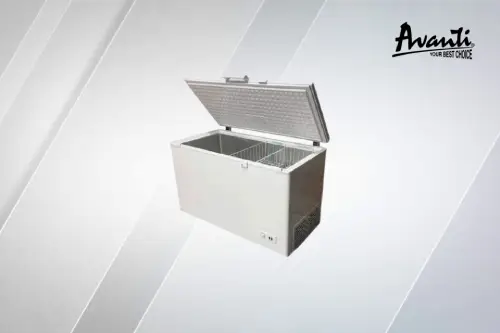
Avanti Freezer Repair
Avanti freezer manuals carry no error code table. They troubleshoot by symptom, which means the diagnosis is done with a meter and a thermometer rather than read off a display. Our general freezer repair page covers the same work on other makes.
A freezer running warm starts at the gasket. A lid seal that has taken a set stops sealing along one edge, and the unit ices up there first while the compressor runs continuously trying to keep up. After the gasket it is the thermostat. Heavy frost on the walls of a manual defrost model is expected rather than faulty; if it comes back within days of a defrost, the seal is the reason.
One thing worth knowing before you call: if the freezer sits somewhere that gets genuinely cold, an older thermostat sensing cabinet air alone can stop cycling in winter, and the contents soften while the unit looks like it is behaving normally.
Avanti Dishwasher Repair
Avanti dishwashers, including the 18 inch built-ins and the countertop units, use an F-code scheme. It is the only Avanti product family that does, and the full table appears further down this page.
What matters when you read one is that Avanti splits its own codes into two groups. FF and F2 come with owner checks: open the tap, clean the inlet hose filter, clear the drain hose and filters, and make sure the kitchen sink itself is draining. Every other code in the list, F1, F3, F5, F6, F7, F8, F9, FE and HI, carries the instruction to stop and call for service. That is the manufacturer's own division, not ours.
Two other calls worth checking yourself first: a dishwasher that is not filling usually starts at the supply tap, and a soap dispenser that will not open is often a latch obstructed by a tall item in the top rack. A sudden loud noise is worth stopping for, since it is usually something loose in the sump.
Water on the floor is the call we get most, and it is worth checking the rinse aid before booking. Avanti warns that an overfilled rinse aid dispenser causes foam, and foam coming out of a dishwasher looks exactly like a leak on a kitchen floor. After that it is the door seal and whether the machine is level.
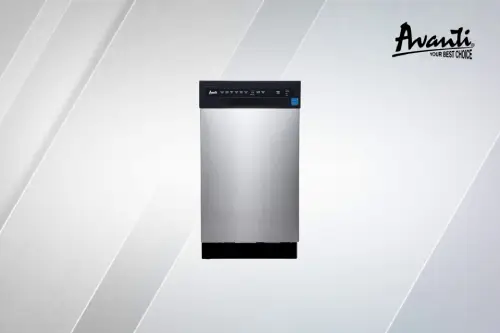
Avanti Washer Repair
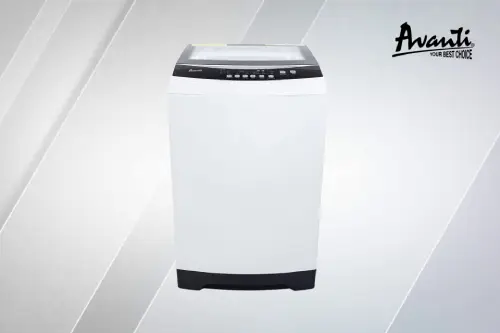
Avanti laundry runs from a 0.84 cubic foot portable up to full top loaders and a front loader. The portables are the ones that generate the calls, because they get wheeled to the sink, connected, disconnected and put away again, and almost none of that is good for hoses or for levelling.
The portable washers do publish codes, and they are the trap on this brand. These come from Avanti's own portable washer manual, so check yours before assuming they apply to a larger model. E1 is the water supply valve, E2 means the top cover is open, E3 is an unbalanced load, E4 is the drain pump and E6 is the door lock. Those are not the same E-codes as the wine coolers use. E1 on an Avanti cooler is a temperature sensor; E1 on an Avanti washer is a water valve. Reading one list against the other gives you the wrong answer every time.
On the front loader in the range, a drum that will not spin follows the same order of checks, and a musty smell is residue in the door seal and dispenser rather than a fault.
Two of those five need no technician at all. E2 clears by shutting the lid, and E3 clears by redistributing the load. Try both before you book. Avanti is also explicit that these machines have to be levelled to work properly, and a portable standing on a kitchen floor usually is not.
Avanti Dryer Repair
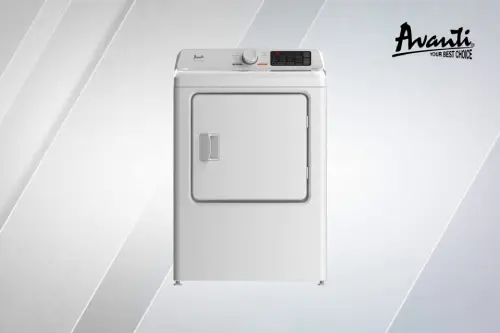
The compact dryers publish no code table, so a dryer that tumbles without heat is diagnosed by measurement: the element, the thermostats and the thermal fuse, in that order, with the vent run checked in the same visit.
That last part matters more on a compact machine than on a full-size one. There is very little reserve in a small heater and a small drum, so a partly blocked lint filter or a long exhaust run shows up as clothes needing two or three cycles long before a full-size dryer would complain. Clearing the duct is often the whole repair.
A dryer that stops part way through a cycle or will not start at all is usually the thermal cut-out or the door switch, and squealing is the drum rollers and belt. Our general electric dryer repair page covers the same work on full-size machines.
A burning smell means stop using it. Lint sitting against a heating element is how dryer fires start, and the size of the machine makes no difference to that.
Avanti Range and Oven Repair
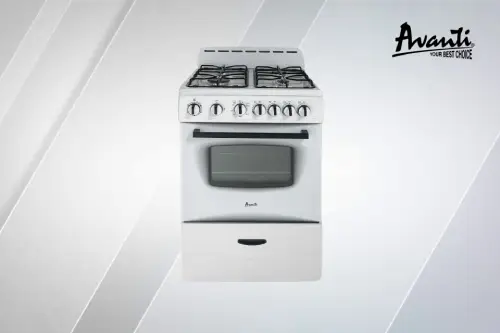
Avanti's 20 and 24 inch electric ranges are the apartment, basement suite and cottage answer to a full-size range, and they carry no code display. Everything is diagnosed at the component.
An oven that runs hot, runs cold, or refuses to heat starts at the oven sensor and its connector. The sensor is a resistance device, it is inexpensive, and it drifts with age; we measure it cold against the manufacturer's figure before anyone talks about a control board. If the oven is completely dead while the surface still works, check the breaker before booking, because a 240V range can lose one leg and still appear partly alive.
An oven that has become noisy is usually the convection fan on models that have one. On the cooktop, a single element that will not heat is the element or the receptacle it plugs into. Burnt contacts in that receptacle are ordinary where a pot has boiled over, and fitting a new element into a damaged receptacle destroys the new element, so both get inspected together.
We service electric ranges and cooktops. Gas appliances are outside what we take on at present.
Avanti Cooktop Repair
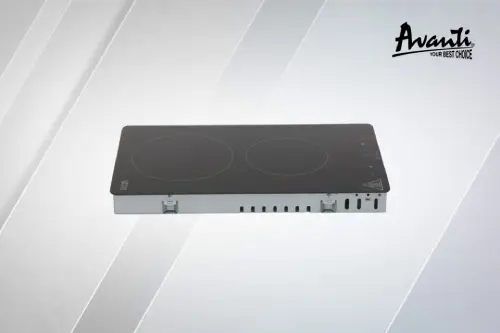
Built-in Avanti cooktops fail in a small number of ways. On coil and solid-element tops it is the element or its connection. On glass and ceramic tops it is a cracked surface, a failed touch control, or a cooling fan that has stopped and pushed the board into protection.
Our general stove and cooktop repair page covers the same faults on full-size units. Telling those apart before ordering matters, because a replacement glass top and a replacement control board are very different numbers, and on a compact appliance either one can approach the value of the unit. We quote both the part and the honest verdict on whether it is worth doing.
Three Things to Check Before You Book
Avanti's compact appliances have a few behaviours that look like faults and are not. Each of these has sent a technician to a house that needed nothing.
- The fridge dial at 0. On the compact refrigerators, 0 stops cooling without turning the appliance off. The light works, the fan runs, the cabinet warms. Avanti suggests starting at 5 and settling around 3 for home or office use, and our guide to the right fridge and freezer temperatures explains what those numbers should actually deliver.
- Where the appliance stands. Avanti asks for a room above 16°C and below 32°C. A garage, an unheated basement or a sunroom in July falls outside that, and no part replacement changes it.
- Whether it has been upright long enough. After any move, Avanti says to let the unit stand upright about two hours before plugging it in. A compact fridge switched on straight off its side can run without cooling, and that alone accounts for a share of the "dead on arrival" calls we get.
If those three are clear and the appliance still misbehaves, the fault is real and worth a visit.
Avanti Error Codes, by Product Family
Avanti has no single code list. Three product families publish codes, and the three schemes share nothing but their letters. Refrigerators, freezers, dryers and ranges publish no codes at all and are diagnosed by symptom.
Wine cooler and beverage centre codes
| Code | What Avanti says it reports |
|---|---|
| E1 | Temperature sensor failure |
| E2 | Temperature sensor failure |
| E3 | Defrost sensor failure |
| E4 | Defrost sensor failure |
| HH | High temperature alarm. The trigger point differs by model, from 78.8°F on one cabinet to 99°F (37°C) on another |
| LL | Low temperature alarm, below 32°F (0°C) |
Dishwasher codes
| Code | What it reports | What Avanti tells you to do |
|---|---|---|
| FF | Water inlet system failure | Check the tap is open, clean the inlet hose filter |
| F2 | Inability to discharge water | Check the hose and filters for clogs |
| F1 | Overflow | Unplug the machine, close the tap, call for service |
| F3 | Continuous water input | Close the tap and call for service |
| F5 | Pressure system failure | Call for service |
| F6 | Faulty heater sensor | Call for service |
| F7 | Overheating | Call for service |
| F8 | Heater error | Call for service |
| F9 | Diverter position error | Call for service |
| FE | Faulty electronic card | Call for service |
| HI | High voltage failure | Call for service |
Portable washer codes
| Code | What it reports | What to try first |
|---|---|---|
| E1 | Malfunction in the water supply valve. No water, a supply timeout, or a clogged valve | Open the tap, check the hose is not kinked or frozen, clean the inlet screen |
| E2 | Top cover is open | Shut the lid. This one needs no technician |
| E3 | Unit is unbalanced | Stop, redistribute the load evenly, restart. Also check the machine is level |
| E4 | Malfunction of the water drain pump | Check the drain hose is not squashed or bent before booking |
| E6 | Door lock malfunction | Call for service |
Anything above comes from Avanti's own model manuals. Where a code is not in this page it is because we could not tie it to an Avanti source, and we would rather leave a gap than fill it with a guess. Read us the code together with the model number off the rating plate and we will tell you which scheme it belongs to.
What Avanti Makes, and Where the Warranty Stops
Avanti builds compact and specialty appliances: mini and apartment-size refrigerators, wine and beverage centres, freezers and ice makers, dishwashers including countertop models, compact and portable laundry, 20 and 24 inch ranges, cooktops, microwaves and compact kitchen units. It is a full catalogue in small sizes rather than a small catalogue. We repair the built-in and over-the-range microwaves in that list; countertop units are rarely worth a technician visit and we say so on the phone rather than after we arrive.
The part Canadian owners tend to discover late is the warranty. Avanti's warranty text states that "the warranty does not apply outside the Continental USA." That same sentence appears in the manuals for the dishwashers, the compact refrigerators and the portable washers, so it is a standing term rather than a quirk of one product.
The practical meaning is straightforward. If you bought an Avanti here, or carried one over the border, the factory has no obligation to service it and there is no Canadian warranty depot to send it to. Independent repair is the route, and that is true from the day the appliance arrives rather than after a warranty period expires.
Two things follow from it. Keep your model and serial number, because parts for compact appliances are model-specific and there is no local dealer network to look them up for you. And ask for the repair-or-replace verdict honestly, because on a small appliance a control board can approach the value of the machine. We give you that number before starting, and we say when the answer is replace.
Parts for an Avanti in Canada
Avanti parts are ordered against the model and serial number on the rating plate, and the plate is the whole job. On a compact refrigerator it is usually inside the cabinet on a side wall. On a wine cooler, inside the door frame. On a dishwasher, the edge of the door. On a portable washer, the back panel.
Some parts are generic and stocked widely: door gaskets, thermostats, temperature sensors, inlet valves, drain pumps, heating elements, dryer thermal fuses. Those we can usually source without a long wait. Control boards and cabinet-specific parts like a glass door or a fitted shelf are the slow ones, and on a brand with no Canadian service network they can be slow enough that replacement is the better answer. We tell you which category your part falls into when we quote, rather than after you have waited three weeks.
Common parts travel on the van, so a good share of Avanti repairs finish in one visit.
Frequently Asked Questions
Is my Avanti under warranty in Canada?
Almost certainly not. Avanti's own warranty text says it does not apply outside the continental USA, and that wording appears across its dishwasher, refrigerator and laundry manuals. There is no Canadian warranty depot, which is why independent repair is the practical route here.
My Avanti fridge is not cold but it is running. What is wrong?
Check the dial first, because 0 stops the cooling without switching the appliance off. Then check where it stands: Avanti rates these for a room between 16°C and 32°C, so a garage or cold basement is outside spec. If both are fine, the usual faults are the door gasket, a dust-packed condenser coil or the sealed system, and the last of those needs an ODP-certified technician.
Why does my Avanti chiller compartment not keep ice cream frozen?
Because it is not meant to. Avanti's manual says the chiller compartment is not a true freezer and may not keep ice cream frozen, and rates it for ice cubes and three to four days of frozen food.
My wine cooler shows E1. Is that expensive?
Usually not. On the cooler family E1 and E2 are a temperature sensor and E3 and E4 a defrost sensor. Sensors are inexpensive parts and short jobs. Be sure you are reading the cooler table though, because E1 on an Avanti washer means something completely different.
My dishwasher shows F2 and there is water in the bottom.
F2 is a drain fault, and Avanti's own first instruction is an owner check: clear the hose and filters, and make sure the kitchen sink itself is draining. If the sink is slow, the dishwasher is a symptom rather than the problem. If the sink is fine and the tub still holds water, the pump is next and that is our job.
Do you work on gas Avanti appliances?
Not at present. We service electric ranges, cooktops, dryers and all of the refrigeration and dishwashing range.
Is a compact appliance worth repairing?
Often, and sometimes not. A gasket, thermostat, sensor, pump or element on an Avanti is usually worth doing. A control board or a cabinet part on an inexpensive compact unit sometimes is not, and our guide on whether to fix or replace a refrigerator walks through the same arithmetic. We diagnose, quote the whole job, and say plainly which side of that line your appliance falls on before you commit.
How is the repair priced?
Labour runs $92 to $278 depending on the job, plus parts. Our technician diagnoses at your address and gives you the price before starting. The service call is free when you go ahead with the repair, and completed work carries up to three months on parts and labour.
Where do you repair Avanti appliances?
Across the Greater Toronto Area, Barrie, London, Ottawa, Vancouver, Winnipeg, Halifax and New York City, each with its own local number. The service areas page lists the number nearest you.
Other Brands and Appliances We Repair
If Avanti sits alongside full-size appliances in your kitchen, our fridge repair, dishwasher repair, washer repair, oven repair and stove and cooktop repair pages cover those. For other compact and specialty makes, see Danby, Marathon, Haier, Magic Chef, Insignia and Hisense. For wine and beverage cabinets, see Cavavin and Marvel.


